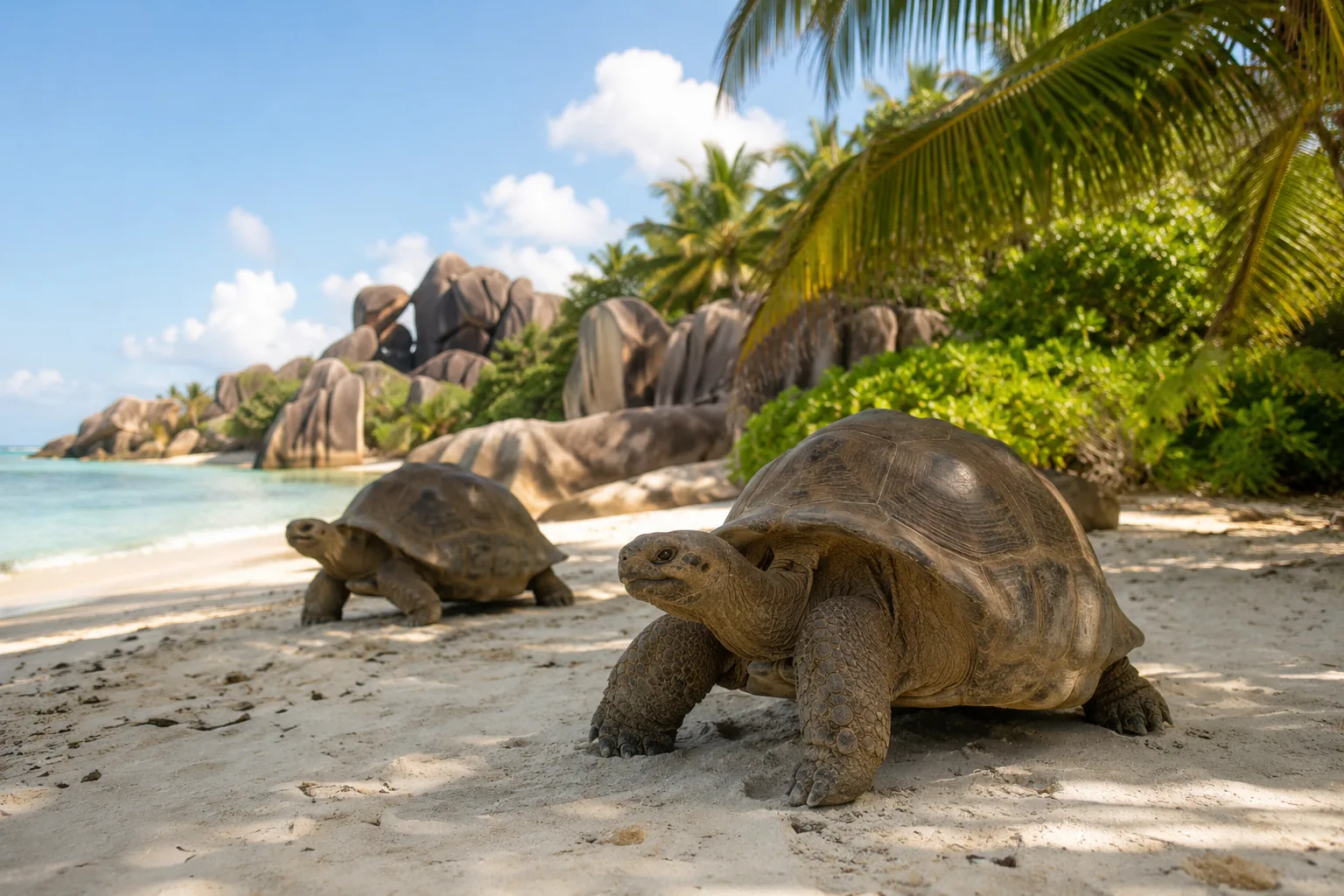
There are moments in Seychelles that no photograph quite prepares you for. One of them is rounding a corner of a tropical garden path and finding yourself face to face with a creature that weighs 250 kilograms, stands half a metre tall at the shoulder, and was alive when your grandparents' grandparents were born. The Aldabra giant tortoise — Aldabrachelys gigantea — is the world's largest land tortoise, and it has made Seychelles its home for longer than any human civilisation has existed on these islands. Owners at Empathia Village share their garden, their hillside and their mornings with them.
What they are
The Aldabra giant tortoise is named for Aldabra Atoll — a remote coral atoll in the outer Seychelles, 1,100 kilometres south-west of Mahé, that is one of the last truly wild places on earth. Aldabra is home to the world's largest population of the species: approximately 100,000 individuals living on an atoll that has been a UNESCO World Heritage Site since 1982. The tortoises are the ecological equivalent of elephants on the atoll, shaping the landscape through their grazing in the same way that megafauna shape savannah ecosystems.
On Mahé and the inner islands, the tortoises found in hotel gardens, private estates and conservation areas are descended from populations relocated from Aldabra and other outer islands during the 19th and 20th centuries — some as pets of colonial administrators, some as part of early conservation programmes. Today they are a protected species throughout Seychelles, with a stable and growing population across the inner islands. Many individuals on Mahé are known by name and have lived at a single location for decades.
Their history in the Indian Ocean
Giant tortoises once inhabited every suitable island in the Indian Ocean. The Indian Ocean islands were, before human settlement, some of the densest concentrations of giant tortoise populations in the world. The arrival of European ships in the 15th and 16th centuries began a catastrophic decline: the tortoises were easily caught, survived for months without food or water in a ship's hold, and provided fresh meat for crews on long voyages. Within two centuries, the giant tortoises of Mauritius, Rodrigues, Réunion and the Mascarenes had been hunted to extinction.
Aldabra's isolation saved its tortoise population. The atoll was too remote, too shallow in its approaches and too lacking in resources to attract regular shipping. When the naturalist Charles Darwin identified Aldabra's tortoises as a species of extraordinary scientific importance in the 19th century, and when the Seychelles government began formal protection in the 20th, the population was large enough to survive and recover. Today the Aldabra giant tortoise is classified as Vulnerable rather than Critically Endangered — a conservation story that Seychelles is rightly proud of.
Living alongside them
For owners at Empathia Village, the tortoises are not a tourist attraction or a managed exhibit — they are neighbours. The hillside above Baie Lazare supports a small population of individuals that move freely through the tropical vegetation, foraging for fallen fruit, grass and leaves in the early morning and late afternoon. They are unhurried, unbothered by human proximity and, once you have spent a few mornings watching one make its considered way across your garden, deeply calming to be around.
There is something philosophically grounding about sharing a landscape with an animal whose lifespan encompasses your entire family history. A tortoise that was already old when your villa was built will, in all probability, outlive the building itself. Seychellois culture has absorbed this perspective: the tortoise is treated with a combination of affection and respect that reflects both its protected status and the understanding that it belongs here in a way that no human settlement entirely does.
Conservation and Seychelles' wider commitment
The Aldabra tortoise is one symbol of a broader conservation commitment that defines Seychelles as a nation. The country has protected over 50% of its land area and 30% of its ocean territory. The Seychelles government has undertaken a landmark debt-for-nature swap — retiring a portion of its national debt in exchange for binding commitments to marine conservation — that is now studied internationally as a model for small island states. Seychelles was, in 2020, named one of the world's leading ocean conservation nations by the High Level Panel for a Sustainable Ocean Economy.
This commitment is not merely governmental. It is embedded in the culture of the islands in a way that visitors notice within days of arriving. The natural environment of Seychelles is not treated as a backdrop to development — it is treated as the primary asset, the thing that makes everything else possible. Empathia Village's design reflects this: the estate is positioned on a hillside, not a beach, preserving the natural coastline below while allowing every villa a view of it. The tropical planting on the estate is chosen to support the biodiversity of the hillside — and to remain hospitable to the ancient, unhurried residents who were here long before us.
What to expect as a resident
First-time visitors to Seychelles are sometimes surprised by how naturally the wildlife coexists with the human population. There is no separation between the managed and the wild: fruit bats roost in garden trees, paradise flycatchers nest in the takamaka, hawksbill turtles lay their eggs on beaches that people swim from every morning. The Aldabra tortoise is part of this continuum — protected, present and entirely real in a way that no zoo or conservation centre can replicate.
As an owner at Empathia Village, you will find that the island gives you time to notice these things. The pace here is not the pace of a holiday itinerary — it is the pace of a place that has no particular interest in hurrying. A morning coffee on the terrace with an ocean view and a tortoise moving through the garden below is not a remarkable event here. It is simply Tuesday. If you would like to see this for yourself, contact our team to schedule a private consultation to the estate and the bay below it.